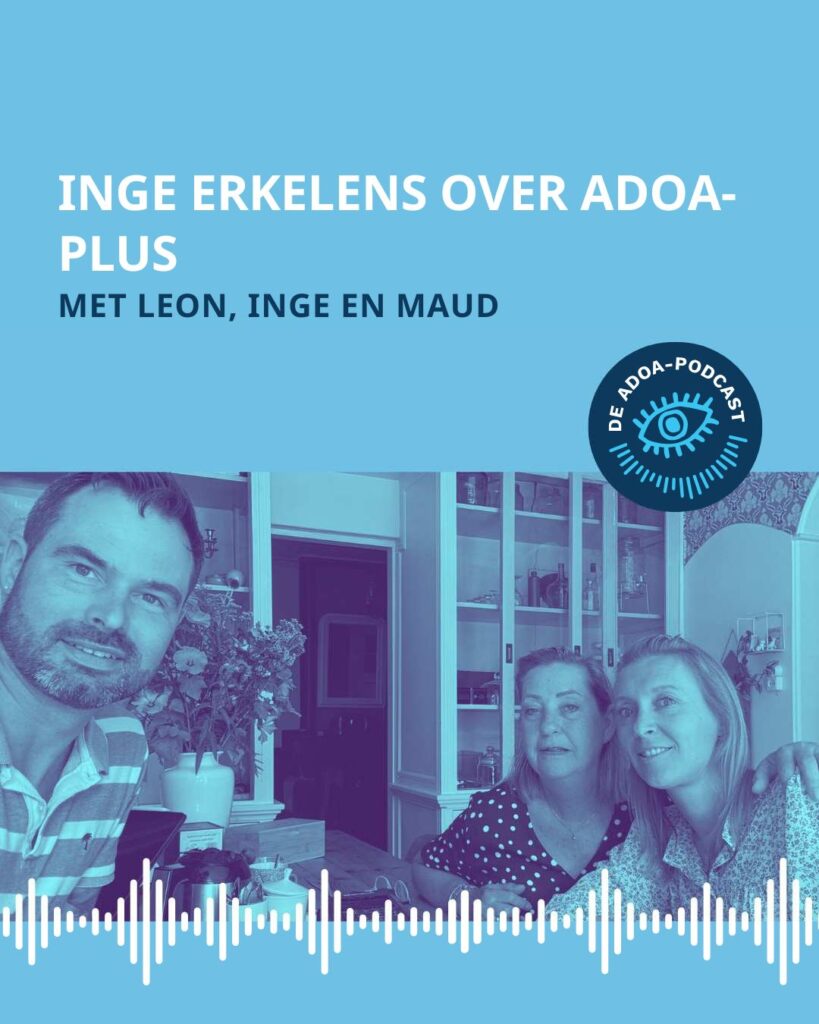
The eighth episode of the ADOA podcast is online. In this episode you will hear Inge Erkelens. Inge is 69 years old and has ADOA-plus herself. She is very involved in the activities of the Cure ADOA Foundation
🗣️ In the podcast, Inge talks about the progression of her complaints and the search for a diagnosis. Be inspired by her perseverance and positive attitude!
Listen to the episode via:
Below you will find the transcript of this podcast.
00:00:03
Maud: Welcome to the ADOA Podcast. ADOA is a very rare hereditary eye condition. My name is Maud van Gerwen and I am here with…
00:00:11
Lion: Leon Augustijn. Together we will talk to professionals and experts about their view on ADOA. Welcome to this podcast. Well, welcome Inge! Nice that you are participating in this podcast.
00:00:27
Inge: Nice, cozy, good morning.
00:00:30
Lion: And who is Inge?
00:00:32
Inge: “Who is Inge? Inge is 69 years old, I have worked my whole life since I was eighteen. I worked in a women's and men's clothing store with sewing that I did, some seamstress work, and displaying, sales, purchasing, I worked there for eighteen years. Then I started for myself, had a store here in Gouda for 12,5 years.
00:01:02
Lion: Okay.
00:01:03
Inge: And then I worked for three years in a nursing home as the first employee in the linen room. Then I moved to Spain with my now ex-husband. I lived there for 5,5 years, and after 5,5 I got divorced, came back, and then I was 58. At that time there was a huge unemployment here, so then I could go back to my old boss. There I really worked in the nursing home with people who were suffering from dementia. I really enjoyed that, because it was a really nice job. But yes, when I turned 65 my body was done and I got all kinds of complaints, also mainly due to the disease 'ADOA'. So I stopped working and then my brother got sick. We took care of my brother for six years, also as a caregiver. My brother also had ADOA, he had ADOA-plus, but he also had a very nasty disease, called 'CASPR2', encephalitis, which caused him a lot of pain. He was almost blind, he was stone deaf, and that was very difficult and hard to take care of him. In the meantime I have met a second partner, and he lived diagonally across from my brother and sister-in-law, and from there I could of course also do a lot for my sister-in-law. During the hours that she did indeed go to work, and could also do her own thing, I was there for my brother. And also, at a certain point it went on of course with showering and medication, and he also had some help, but that also often went very wrong. So at a certain point he fell a lot; he fell out of his mobility scooter, he was blind, he was actually not allowed to drive that mobility scooter anymore, and he went to walk the dog every day - three times a day -, so that was very difficult. He died 2,5 years ago of lung cancer. With everything he had actually.
00:03:48
Lion: Yeah. If you look at that ADOA, because did you know that you had that, or…?
00:03:54
Inge: No, we didn't know we had that. We thought we had Leber's disease. They have a son who also started to see worse. So he went to the eye hospital, he happened to end up with a very good ophthalmologist, and he referred him to have blood tests. He had a gene test, and it showed that he had the OPA1 gene, so ADOA. I think that happened four or five years ago. I'm 69 now, so I also went back to the eye hospital in connection with this to have gene tests examined. And yes, the same thing came out for me, unfortunately. And in that period, the fact that the ADOA Foundation was founded also started to play a role - they've been around for about 5,5 years now.
00:05:00
Maud: The foundation, yes.
00:05:02
Inge: Yes. I joined that at that time, also together with my sister-in-law. And of course she was also very closely connected in connection with her son. Of course we all try to get as many sponsors as possible, and all that kind of thing.
00:05:22
Maud: Of course.
00:05:24
Inge: We have done a lot, especially last year. We did the ZieZo fair, and I was also in 'the goals' with the congress of neuro-ophthalmology doctors. There is just a lot going on at the moment with research and such. It is just very interesting to be involved in that too, especially.
00:05:49
Lion: Yeah. And if you look at the beginning, how did that go for you with the coming about of finding that out? Or was that really that moment of…
00:06:00
Inge: My vision became… When I had the shop here in Gouda, it was in a very small street too, I was sitting behind my sewing machine and looked across the street, and I could no longer see the letters of the neighbor across the street, what number he lived at. So then I was referred to the eye hospital via the family doctor, and there I saw a doctor who also had my brother, and he said: “Yes, you have Leber's disease”, they thought. So I actually still wonder how many people with Leber's disease also have ADOA instead, because there has not been proper research into it, or is sometimes not being done. I think it is just very important in particular.
00:06:52
Maud: That's right.
00:06:54
Inge: There is a very good doctor in the eye hospital who is also involved with you now and then, with the foundation. But yes, they have a shortage of those kinds of ophthalmologists, so that is also a problem actually. Anyway, when I went to the eye hospital I think one eye had 30%, and the other eye 60%.
00:07:22
Lion: What now?
00:07:24
Inge: 20%. Over the years… I drove a car until I was 65 – I can compare it a bit – but that was irresponsible.
00:07:44
Maud: Because how old were you when you first came to that eye hospital?
00:07:49
Inge: I think 35 or 36.
00:07:53
Inge: Oh yeah.
00:07:55
Inge: But especially when you drive a car, and I noticed that I became night blind at night or in the evening. Also when I was driving on the main road, and you see signs, I didn't see the signs, and then I thought: "Oh, I don't think that's good". And nobody in our family had anything like that actually. Yes, I knew a little bit about my brother that he had a little less vision, but not like that. So with him it also got worse over time, and that's why he was declared unfit for work. And my sister - I also had a sister - she lived to be 38, she had it too, and we probably got it from my mother, but we can't find out anymore of course. But the rest of the family with us, with the uncles and aunts and such, they don't have anything as far as I know.
00:08:46
Lion: No, that's all in hindsight now. I can imagine when you're in that process, you think: "Well, it's just... the ophthalmologist will take care of it, he knows about it."
00:09:01
Inge: Yes, but then you go out the door, and then they say: "Well, learn to live with it, and figure it out". Yes, that. I am quite enterprising myself to look and search, and you also have to do a lot of research via the internet. And now in recent years, of course, a lot has been done in this area. I just try to do a little birding about that kind of thing, and also to make others a little wiser in this as well.
00:09:37
Maud: Because between the day you were diagnosed with Leber and the day your brother's son was diagnosed, you never went to an ophthalmologist or anything like that?
00:09:54
Inge: No, no, no, no. There were thirty years in between. That's crazy, isn't it?
00:10:01
Maud: Yes.
00:10:02
Inge: My brother never actually went back to the eye hospital, and of course he was really deaf at the end, he really couldn't do anything anymore. And I'm starting to go deaf now too. The ADOA-Plus is also starting to play up for me now, especially my eye, which paralyzes the eye muscles, so that eye squints a bit. I have beautiful glasses with prism lenses.
00:10:34
Maud: Glad that helps.
00:10:35
Inge: Yes, so I'm very happy about that, because through this one eye I saw double, but I had been walking around with that for a long time actually before I had reported it to the eye hospital. But a bit stupid of me also with driving, and then I closed one eye, and then I was driving in the evening. That's not good, right?
00:10:56
Maud: No, that's not good.
00:10:57
Lion: That's not convenient.
00:10:58
Inge: No, but I also tried to ride with BTS glasses in the meantime – these are special glasses with a case on them – but that didn't quite work.
00:11:11
Inge: No? Your vision wasn't good enough for that?
00:11:14
Inge: Too little visibility, yes. That is just very difficult to get under such a very small tube… then you have to look for the signs with that eye. No, that… But now with my glasses I would still dare to drive.
00:11:30
Lion: Ja
00:11:31
Maud: Crazy to say.
00:11:33
Inge: I don't do it anymore, no. I also stopped driving at the same time, which I think is a shame, but oh well. And for the rest, I just try to participate in everything. I played sports for years, I played badminton, but at some point I stopped because I fell twice badly in the hall, and once I lost consciousness, and the second time I fell really badly, also on my head. When you start playing, you start to play a bit, and suddenly one of my legs goes out from under me, no more strength for a moment. But afterwards... now a lot of things come back, that I think: "Yes, now I understand", because of course it is also a disease of the mitochondria - and those are the energy factories of your body -, that is everywhere, with your eyes, with what is inside, everything, your intestines, you name it.
00:12:41
Lion: But how do you deal with that search? And that feeling of: "Yes, when will it get worse?", or: "When will it remain stable?". I can imagine that it causes internal stress.
00:12:55
Inge: Well, I have to be honest, I think that maybe that comes a bit with age, that you are a bit resigned at a certain point. I think when you are younger, especially my nephew, he bury his head in the sand, and you think: “Well…and my aunt will just figure it out”, you know? That of: “You are then searching and doing, and we will come to something later, hopefully”. But I did say that he goes to the eye hospital, to the ophthalmologist, every year, and that that is just important. But every year when you go to the eye hospital you are confronted with these kinds of things. That is difficult for young people. It doesn't matter that much to me. But what I am actually trying to do, also for the young people, of course there are also a lot of young people at the foundation who have this, and who have also been visually impaired at a very young age, worse vision than I was. Because it is different for everyone.
00:14:08
Lion: And what has helped you over the years?
00:14:12
Inge: Well, I think my character. I'm a go-getter, I'm definitely a go-getter. Yes, I don't give up. If it doesn't go left, it goes right. I always try to find a way to get out of something.
00:14:31
Lion: And what tips do you have for people who are not so persevering, or who think: “Well, the walls are closing in on me”?
00:14:39
Inge: Get outside. Do something nice for yourself, go for a nice walk, get a pet, make sure you have people around you who also think along with you, and don't criticize you, or: "Yeah, you can't see anything anyway", and things like that, you know? And it's also very important that you have people around you who are also a little concerned about you of course.
00:15:12
Maud: Definitely yes.
00:15:15
Inge: Yes.
00:15:18
Lion: I can also imagine that perhaps because you are so motivated, have that drive, and are such a go-getter, that this also works for some people's allergies.
00:15:32
Inge: In the…?
00:15:34
Lion: In the allergy. So that people get irritated by it, or that people think: "Well, you always with that story, or this, or that".
00:15:44
Inge: No, that's not so bad. No, I don't have that much trouble with that. I have a really nice sister-in-law, don't you Maud?
00:15:50
Maud: Certainly
00:15:51
[Laughter]
00:15:54
Inge: So no, I have a very sweet girlfriend, and my cousin and my sister-in-law are very sweet, so no.
00:16:06
Maud: And of course you have spent a large part of your life not knowing that you had ADOA, or well, assuming that you had Leber. But then you may not have lived very much according to the fact that you say that you see badly, or that it could get worse.
00:16:26
Inge: Yeah, I just lived my life.
00:16:28
Maud: Ja
00:16:29
Inge: Period. I mean, if you wake up every day thinking: "I might see less today", or: "I won't be able to see anything at all", yeah... You also have to take care of yourself a little bit, that you also eat and things like that... that's very important. Don't smoke, don't drink, things like that. Vitamins and stuff, very important, very important.
00:17:05
Lion: Are there any things you would like to tell the listener? They think: "Well, I've been going to the ophthalmologist for a long time, my eyesight is slowly getting worse", what would you like to tell them?
00:17:17
Inge: Well, especially staying with ADOA, and visiting the open day, and having fun together, because that has also done me a lot of good. It feels to me like we are one family, that is inexplicable, that is really inexplicable. That is very special.
00:17:40
Lion: Yes Yes Yes. And suppose a doctor is listening, what would you like to tell him?
00:17:51
Inge: Well, keep doing a lot of research, yes. And I also think what is very important, is that they also keep sparring with people who have ADOA. Because they also have one very sweet, nice doctor, can I mention his name?
00:18:12
Lion: Sure.
00:18:13
Inge: Doctor De Coo. Doctor De Coo is such a sweet man, and he explains everything to you so well. And he is a child neurologist, that's what he does, but he is also involved in the research.
00:18:26
Maud: Yes, and the medical advisory board.
00:18:27
Inge: Such a wonderfully sweet man, and he listens to you, he talks to you, and I think that we are heard, I think that is very important.
00:18:39
Lion: Yeah, yeah. And for the doctors that you may have seen in the past, who may have given you the wrong diagnosis because they may not have known, what would have helped you during that time?
00:18:54
Inge: Better research, better research. Because that is very important. We are doing that now with ADOA in particular. That research is so important, that you know what you have. The more people have ADOA, the more money comes in.
00:19:11
Maud: Yes, we are of course mainly trying to create more awareness…
00:19:13
Inge: Yes / Yes.
00:19:14
Inge: …also that doctors can make a diagnosis. Because that is often lacking, that they simply do not know it.
00:19:22
Inge: Yeah, yeah. Even a regular ophthalmologist doesn’t know what it is.
00:19:26
Maud: Co-funding is not required.
00:19:27
Inge: But that's very sad, isn't it?
00:19:28
Lion: Of course.
00:19:29
Inge: Yes.
00:19:31
Lion: That is of course the goal and mission of the foundation, to really bring about a change in this regard.
00:19:40
Maud: Yes.
00:19:40
Lion: But back to that, suppose someone is listening and they think, “Well, I could have it”…
00:19:51
Inge: Yes?
00:19:52
Lion: …what advice would you give to that person? And that person is already going to an ophthalmologist or another doctor.
00:19:56
Inge: Make an appointment at the eye hospital with Dr. Van Everdingen.
00:20:00
Lion: Yes. That is concrete.
00:20:04
Inge: Yes, she is also the one who helped me at that time. She had a diabetes consultation hour and I actually came in by accident, not actually for that consultation hour, and when she heard what I had she pushed everything aside, and I got a pile of papers. I had to go everywhere, and she says: "Yes, then they can just wait in the waiting room", and she really took all the time for me, and that was very nice. I actually already knew the outcome, but now I have it in black and white.
00:20:40
Lion: Yes.
00:20:42
Inge: Yes, being heard too.
00:20:42
Lion: Thanks for listening to this podcast.
00:20:47
Maud: Should you have any further questions or wish to discuss this further? Please contact us via our website adoa.eu.